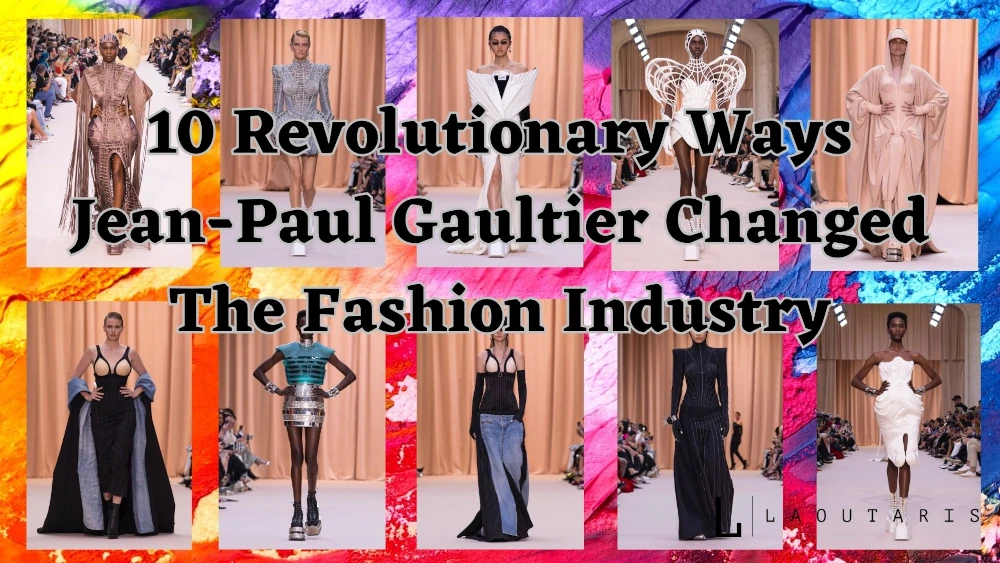
Jean-Paul Gaultier’s journey from a working-class Parisian suburb to one of fashion’s most iconic and enduring names — and how the house he built is being reinvented today.
Table of Contents
The average reading time is 20 minutes. The article was last updated on 04/07/2026.
Thesis statement: Jean-Paul Gaultier’s journey from a working-class background to one of the most iconic fashion designers of our time
Jean-Paul Gaultier, long nicknamed the enfant terrible of French fashion, built a career out of turning underwear into outerwear, dressing men in skirts, and putting corsets, sailor stripes, and tattoo prints at the center of haute couture. Born on 24 April 1952 in Arcueil, a modest suburb just south of Paris, Gaultier had no formal design training. What he did have was a sketchbook, a fascination with his grandmother’s wardrobe, and an unshakeable belief that fashion should reflect the street as much as the salon.

That belief carried him from a teenage apprentice with no diploma to the designer of Madonna’s cone bra, the creative director of Hermès, and — after retiring from the runway himself in 2020 — the founder of a house now being reshaped for a new generation under creative director Duran Lantink. This article traces that full arc: the early influences, the rise, the signature codes that made him instantly recognizable, and where the Gaultier name stands today, in mid-2026.
Early Life and Career
Gaultier was the only child of Paul Gaultier, an accountant, and Solange Gaultier, a clerk. The household was practical rather than artistic — his parents reportedly hoped he might become a Spanish teacher — but two influences pulled him toward fashion from a young age: French television and cinema, and his maternal grandmother, Marie Garrabe.
Garrabe worked as a beautician and was known locally for reading tarot cards on the side. It was her closet, though, that left the deepest mark on her grandson: a collection of vintage corsets and old-fashioned foundation garments that young Jean-Paul found endlessly fascinating. He has said that his very first “design” was a paper cone bra he made for his teddy bear, Nana — named after his grandmother — and that he was inspired early on by the 1945 French film Falbalas, about a Parisian couturier, which made him want to sew rather than simply admire clothes.

By age 13, Gaultier was already producing sketches and small garments for his mother and grandmother. He never attended fashion school. Instead, at 18, he took the more unconventional route of mailing his sketches directly to established Parisian couturiers — a gamble that paid off.
Quick-reference timeline: five decades of milestones
| Year | Milestone |
|---|---|
| 1952 | Born in Arcueil, Val-de-Marne, France |
| ~1965 | Begins sketching designs after watching French TV and films |
| 1965 | Designs his first garments, for his mother and grandmother |
| 1970 | Hired at 18 as an assistant to Pierre Cardin, after sending in sketches |
| 1971 | Brief stints with designers Jacques Esterel and Jean Patou |
| 1971–1974 | Returns to Cardin, managing the brand’s boutique in Manila |
| 1976 | Presents his first individual collection in Paris — his solo ready-to-wear debut, distinct from the formal founding of his label six years later |
| 1982 | Formally founds the eponymous Jean Paul Gaultier fashion house |
| 1993 | Launches his first fragrance, Classique |
| 1997 | Joins the official haute couture calendar under his own name |
| 2003–2010 | Serves as creative director of womenswear at Hermès |
| 2011 | Spanish group Puig acquires a majority stake in the fashion house |
| 2014 | Closes the ready-to-wear line to focus on haute couture and fragrance |
| 2020 | Final haute couture show; retires from active design; guest-designer format begins |
| 2025 | Duran Lantink named permanent creative director |
Apprenticeship: Learning the Trade Without a Diploma
Gaultier’s break came when Pierre Cardin, one of the most influential couturiers of the era, was impressed enough by the teenager’s unsolicited sketches to hire him as an assistant in 1970. It was the closest thing to formal training Gaultier ever received, and it placed him inside one of the most prestigious ateliers in Paris at a formative age.
His path after that was not a straight line. He briefly worked with designer Jacques Esterel and later with the house of Jean Patou, before returning to Cardin — this time being sent to Manila to manage the brand’s boutique there, a posting that put him in contact with high-profile clients, including Imelda Marcos. He left the Philippines after roughly a year, and by 1976 he had presented his own solo collection in Paris, built on a shoestring budget and an early love of pairing rough materials with tailored precision.
That first collection was noticed less for polish than for audacity — leather jackets styled with crinoline skirts, and a willingness to mix codes that were not supposed to mix. Fashion editors including Melka Tréanton at Elle, and Claude Brouet and Catherine Lardeur at French Marie Claire, were early champions who helped bring his work to wider attention, even as more conservative critics dismissed his ideas as excessive.
Rise to Fame
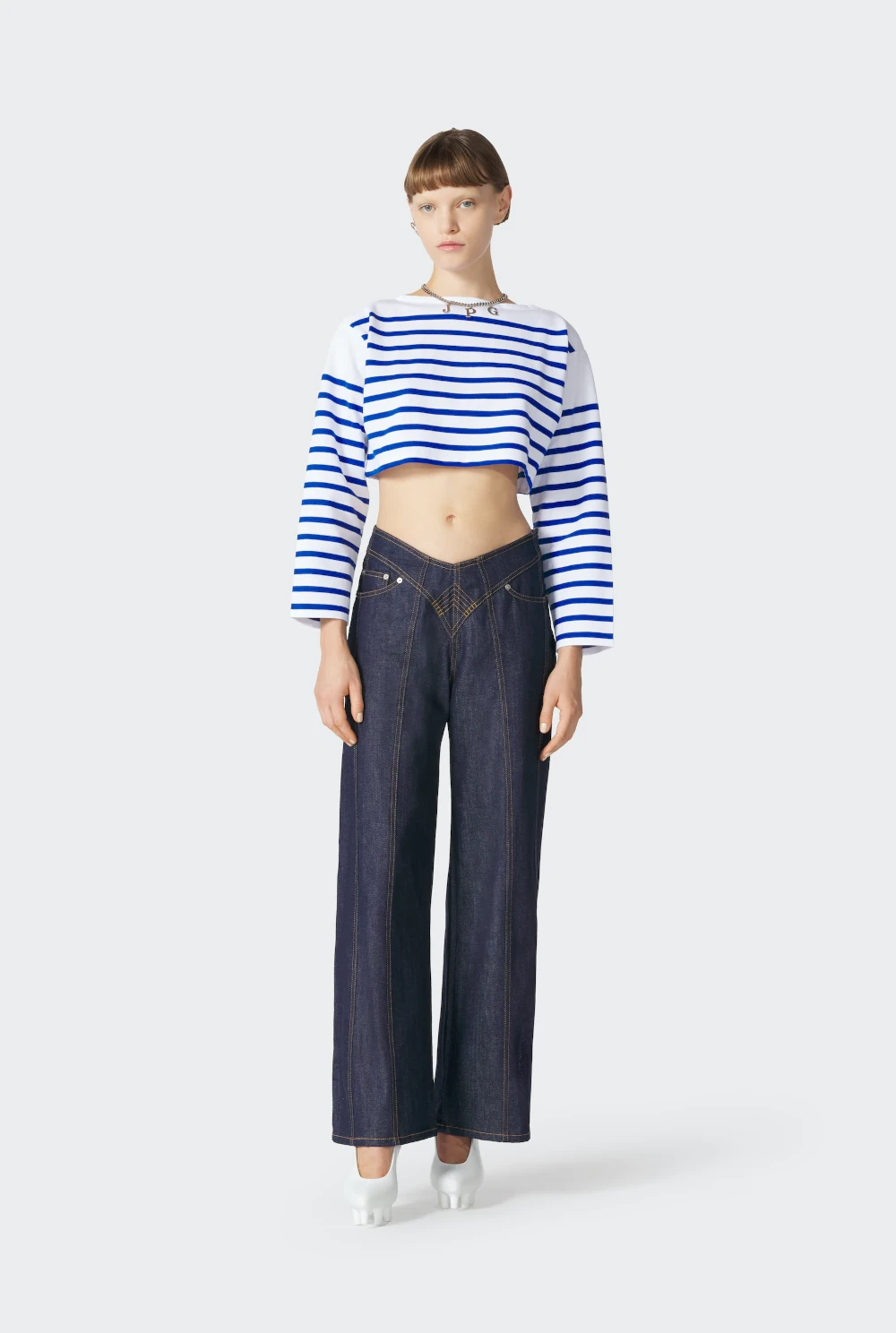
Gaultier founded his own fashion house in 1982, and the years that followed cemented his reputation as fashion’s great provocateur. His 1983 “Boy Toy” collection reintroduced the marinière — the Breton striped sailor shirt — as a menswear staple, while his 1984 skirts for men openly challenged assumptions about masculinity on the runway. That same period brought the corset dress into eveningwear, transforming what had been hidden underneath clothing into the main event.
He worked with unconventional materials — vinyl, metal mesh, tin cans, garbage bags — and drew as much from London club culture and punk as from the ateliers of Paris. Gaultier has said he found the freedom and irreverence of London nightlife more inspiring in that period than the more buttoned-up conventions of the French fashion establishment.
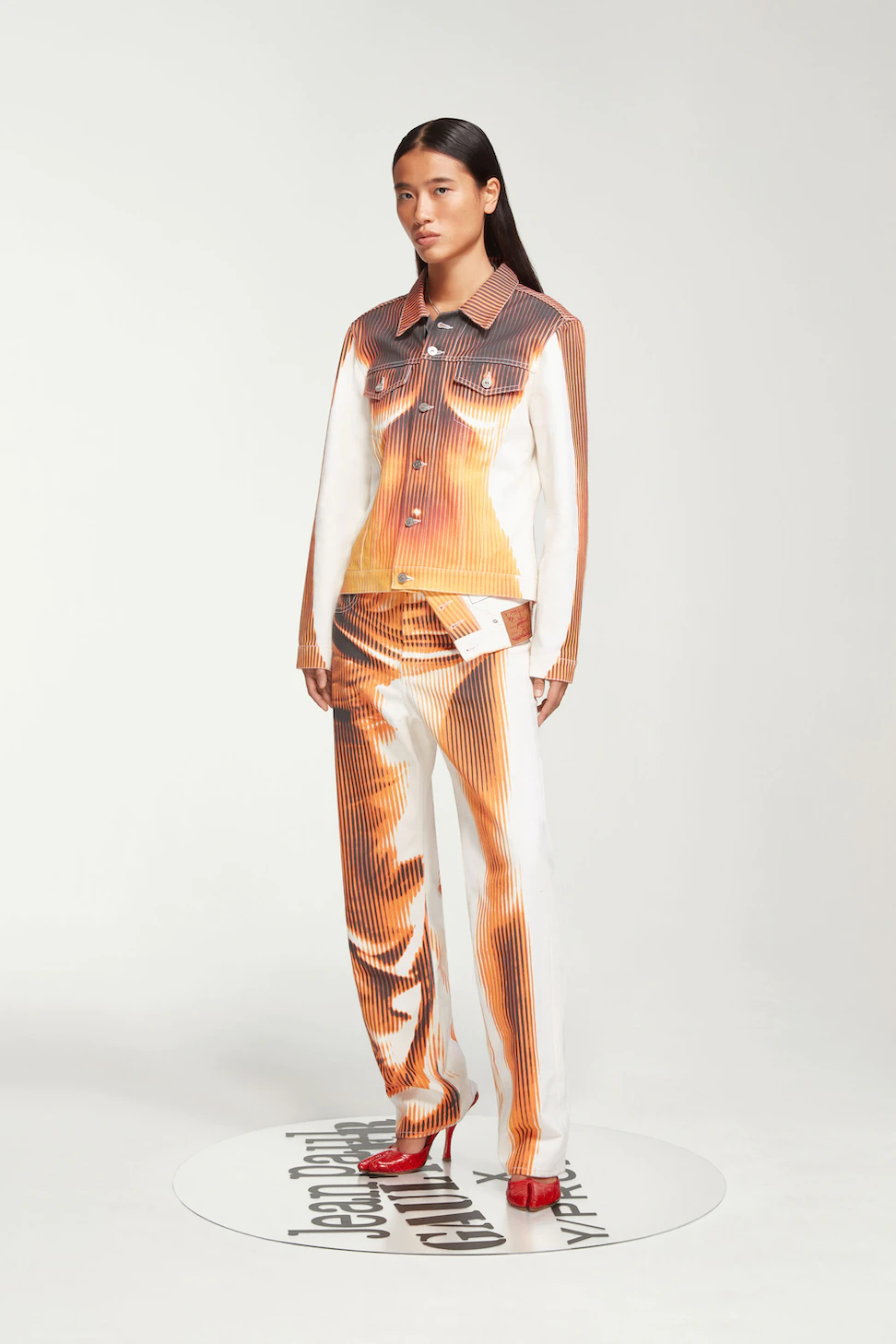
By the mid-1980s, his clothes were being stocked at Bergdorf Goodman in New York, and the term “Gaultiered” had entered fashion vocabulary to describe his knack for twisting a classic garment into something unrecognizable yet familiar. In 1997, after years of being overlooked for top creative posts at older French houses, Gaultier joined the official haute couture calendar with his own label — a move that surprised an industry that had long typecast him as a ready-to-wear rebel rather than a couture-level tailor.
Signature Motifs: The Gaultier Design Vocabulary
Few designers have a visual language as instantly recognizable as Gaultier’s. The table below breaks down his most repeated codes — the elements that make a garment unmistakably his, decades on.
| Motif | What it looks like | Notable appearance |
|---|---|---|
| The marinière | Breton sailor stripes, reworked in unexpected fabrics and silhouettes | “Boy Toy” menswear, 1983 |
| The cone bra/corset | Structured, exaggerated bust lines worn as outerwear | Madonna’s Blond Ambition tour, 1990 |
| Skirts for men | Kilts and skirt-like garments in menswear collections | Autumn/Winter 1984 menswear |
| Tattoo prints | Sheer mesh printed to mimic inked skin | “Les Tatouages,” Spring/Summer 1994 |
| Trompe-l’œil tailoring | Prints or panels that fake a second garment underneath | Recurring across multiple decades |
| Gender-fluid tailoring | Masculine tailoring on womenswear and soft, decorative fabric on menswear | Ongoing house signature |
| Unconventional materials | Vinyl, metal, tin cans, garbage bags reworked into couture | Late 1970s–1980s collections |
These motifs weren’t just shock tactics. Taken together, they amounted to a sustained argument that gender, class, and “good taste” were categories fashion could — and should — question, years before those ideas became mainstream industry talking points.
Celebrity Collaborations and Costume Work
Gaultier’s work has moved fluidly between the runway, the concert stage, and the screen. Below is a snapshot of some of his most culturally significant partnerships.
| Collaborator / Project | Nature of the work | Year(s) |
|---|---|---|
| Madonna | Cone-bra corset, Blond Ambition World Tour; later designed for her Confessions, MDNA, and Celebration tours | 1990, 2006, 2012, 2023 |
| The City of Lost Children | Costume design | 1995 |
| The Fifth Element | Costume design | 1997 |
| Kylie Minogue | Tour costumes, multiple collaborations | 2000s |
| Pedro Almodóvar films (Bad Education, The Skin I Live In) | Costume design | 2004, 2011 |
| Marilyn Manson | Stage and album-era costumes | 2000s |
| Björk | Modeled for Gaultier; featured in Robert Altman’s Prêt-à-Porter | 1994 |
| Nicole Kidman, Marion Cotillard | Red-carpet gowns worn at the Academy Awards | 2003, 2008 |
| Supreme | Streetwear collaboration collection | 2019 |
Gaultier’s willingness to dress musicians, drag performers, plus-size models, and older models on his runways well before “inclusivity” became an industry buzzword is now widely cited as one of his most influential — if less flashy — contributions to the fashion world.
The Fragrance Empire
Gaultier expanded beyond apparel in 1993 with his first perfume, Classique, housed in a bottle shaped like a corseted torso — a literal translation of his design obsessions into glass and liquid. Two years later, in 1995, he launched Le Male, created with perfumer Francis Kurkdjian, which became one of the best-selling men’s fragrances in the world and, in 2025, celebrated its 30th anniversary. The Scandal line later added a further pillar to the fragrance business.
The perfume division proved to be the most commercially durable part of the Gaultier empire. When the Spanish beauty and fashion group Puig acquired a majority stake in the fashion house in 2011, and later took full ownership of the fragrance business, fragrances and beauty products remained central to the brand’s revenue — arguably doing more than the runway to keep the Gaultier name in front of everyday consumers.
The Hermès Years
Between 2003 and 2010, Gaultier served as creative director of womenswear at Hermès, a notable pairing of his provocative sensibility with one of France’s most understated luxury houses. The role required him to tone down some of his usual theatrics in favor of Hermès’s quieter codes of craftsmanship, and it’s often cited by critics as proof that Gaultier’s talent for tailoring went well beyond the shock value for which he was famous. He stepped down from the position in 2010–2011 to focus fully on his own label.
Retirement, and the Guest-Designer Chapter (2020–2025)
Gaultier closed his ready-to-wear line in 2014 to concentrate solely on haute couture and fragrance. Then, on 17 January 2020, he announced — in a cheeky video posted to social media — that his upcoming show, marking 50 years in the industry, would be his last as an active designer. The show itself, staged at the Théâtre du Châtelet in Paris, ran through more than 200 looks and brought together generations of muses, from supermodels to nightlife icons, in what Gaultier later described as a celebration rather than a farewell.
Rather than naming a single successor, Gaultier handed his haute couture atelier to a rotating cast of “guest designers,” each given one season to reinterpret his archive in their own voice. It became one of the most closely watched experiments in modern fashion, running for five years across eight designers before the format was retired in favor of a permanent creative director.
The guest-designer seasons at a glance
All eight guest collections were shown during Paris Couture Week; exact season labels (Spring/Summer vs. Autumn/Winter) have been reported inconsistently across outlets, so the dates below reflect the month and year each show actually took place.
| Shown | Guest designer | Known for elsewhere | Notable direction taken |
|---|---|---|---|
| January 2021 (originally set for July 2020, delayed by the COVID-19 pandemic) | Chitose Abe | Founder of Sacai | Deconstructed, patchworked take on Gaultier’s stripes and corsetry |
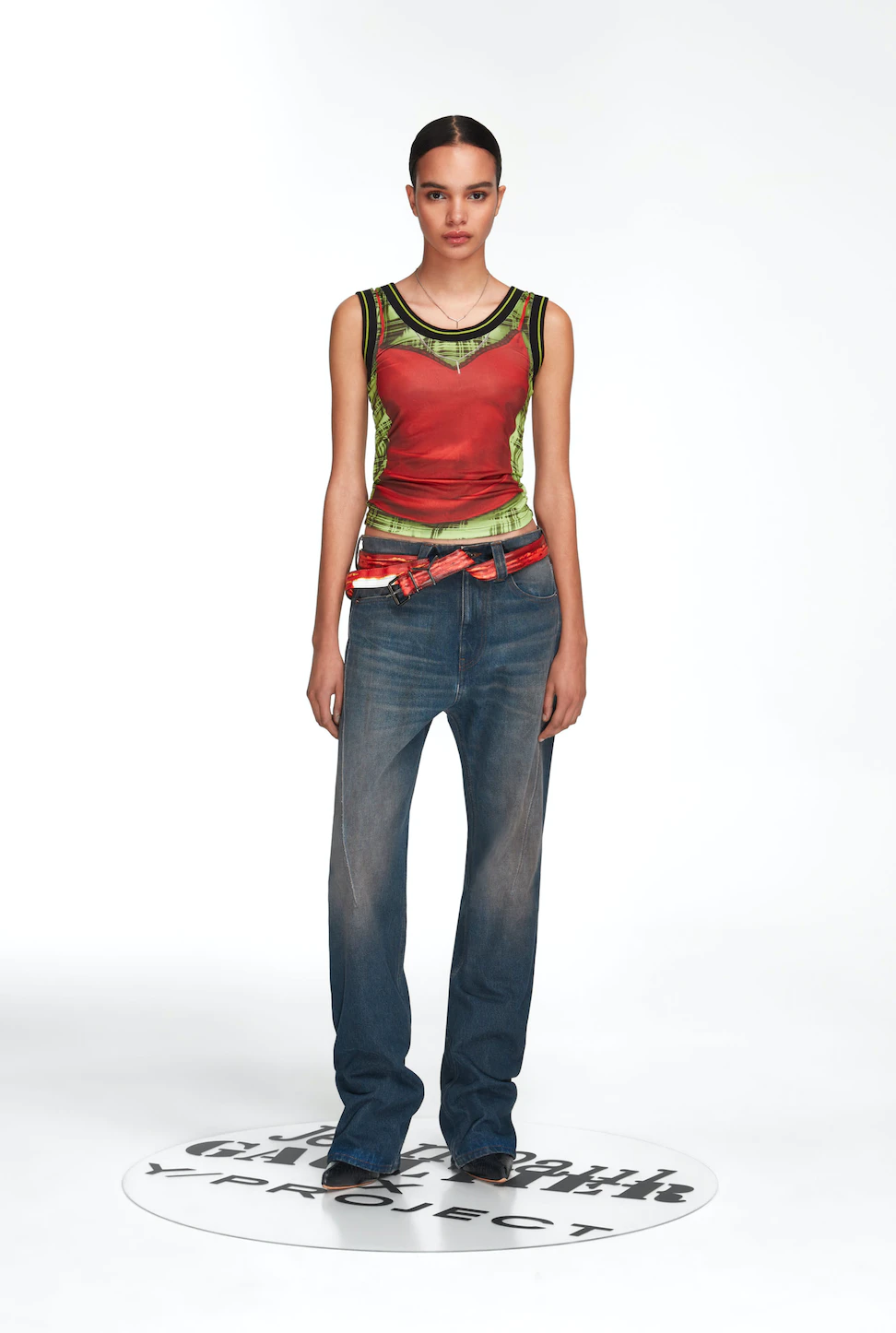
| January 2022 | Glenn Martens | Y/Project; later Diesel and Maison Margiela | Maximalist archive dive, pushing the house’s stripes and curves to extremes |
| July 2022 | Olivier Rousteing | Balmain | Glamorous, tattoo-print homage to Gaultier’s 1994 “Les Tatouages” show |
| January 2023 | Haider Ackermann | His own eponymous label; later Tom Ford | Sensual, minimal draping and sharp tailoring |
| July 2023 | Julien Dossena | Paco Rabanne | A reworked, modernized take on the Gaultier corset |
| January 2024 | Simone Rocha | Her own eponymous label | Romantic volumes, lace, and pearls |
| June 2024 | Nicolas Di Felice | Courrèges | Minimalist, restrained reinterpretation |
| January 2025 | Ludovic de Saint Sernin | His own eponymous label | Gender-fluid, sensual “Le Naufrage” collection |
Each of these eight collections drew significant press coverage precisely because they treated Gaultier’s back catalogue as raw material for interpretation rather than a museum piece to be replicated — a philosophy that would carry directly into the house’s next chapter.
Duran Lantink: A New Era for the House
On 15 April 2025, the house announced that Dutch designer Duran Lantink would become its first permanent creative director since Gaultier’s own departure — taking charge of both haute couture and a revived ready-to-wear line, ending the five-year guest-designer format in one move.
Lantink was, by fashion-industry standards, a relatively unproven choice: born in 1988, he launched his own label in 2016, showed his first solo runway collection in Paris only in 2023, and had, by the time of his Gaultier appointment, won the ANDAM Special Prize (2023), the LVMH Karl Lagerfeld Prize (2024), and the International Woolmark Prize (2025). His own work — known for inflated silhouettes, upcycled materials, and playful gender-bending shapes — had already drawn comparisons to Gaultier’s own early aesthetic, and he has cited Gaultier and Belgian designer Walter Van Beirendonck as major influences.
Gaultier himself framed the choice as passing a torch to a new “enfant terrible,” while Lantink described stepping into the role as an honor and a chance to build on a house defined by provocation and craftsmanship.
What Lantink has shown so far
- September/October 2025 — “Junior” (Spring/Summer 2026 ready-to-wear): Lantink’s debut brought the house back to the ready-to-wear runway for the first time in more than a decade. Named after Gaultier’s 1988–1994 youth-focused diffusion line, the collection reworked the cone bra into a rounded, padded silhouette, used 3D-printed textures to reinterpret Gaultier’s famous 1994 tattoo prints, and drew heavily on Amsterdam’s 1980s–90s club culture, a nod to Lantink’s own upbringing. The reception was genuinely polarized rather than mildly mixed: alongside praise for its energy and inventive silhouettes, the collection drew sharp criticism over several explicit, body-baring prints that some commentators called gratuitous or even sexist, and Lantink himself has since said he was surprised by how strongly that backlash landed.
- March 2026 — Autumn/Winter 2026 ready-to-wear: A more restrained sophomore outing built around reworked tailoring, pinstripe suiting fused with corsetry, and Western-inspired accents, seen by many critics as a calmer, more wearable follow-up to his debut.
- July 2026 — Haute couture debut (Autumn/Winter 2026 Haute Couture Week, 6–9 July): Lantink’s first haute couture collection for the house — originally slated for January 2026 but pushed back — is scheduled to show this month, alongside high-profile couture debuts from other major houses, marking the point at which Lantink formally takes over the discipline Gaultier himself fought to join in 1997.
Whether Lantink can translate his provocative runway ideas into a commercially sustainable ready-to-wear business remains, as of this writing, an open question that fashion press will be watching closely through the rest of 2026.
Awards and Recognition
| Honor | Year | Notes |
|---|---|---|
| Chevalier de la Légion d’Honneur | 2001 | One of France’s highest civilian honors |
| CFDA International Award | 2004 | Awarded by the Council of Fashion Designers of America |
| Museum retrospectives worldwide | 2011–2018 | “The Fashion World of Jean Paul Gaultier: From the Sidewalk to the Catwalk” toured Montreal, Stockholm, San Francisco, Madrid, Rotterdam, New York (Brooklyn Museum), London (Barbican), Melbourne, and Paris (Grand Palais), drawing well over a million visitors |
| Industry recognition for successors | 2023–2025 | Guest designers Haider Ackermann and Duran Lantink later went on to lead Tom Ford and Jean Paul Gaultier, respectively, underscoring the platform’s influence on the wider industry |
Legacy and Continued Influence
Gaultier’s most lasting contribution may be less about any single garment and more about a shift in attitude: the idea that fashion could be intellectually playful, sexually frank, and unconcerned with traditional hierarchies of taste, all at once. His early embrace of gender-fluid tailoring, plus-size and older models, and street-cast faces on the runway anticipated inclusivity conversations that wouldn’t become industry standard until decades later.
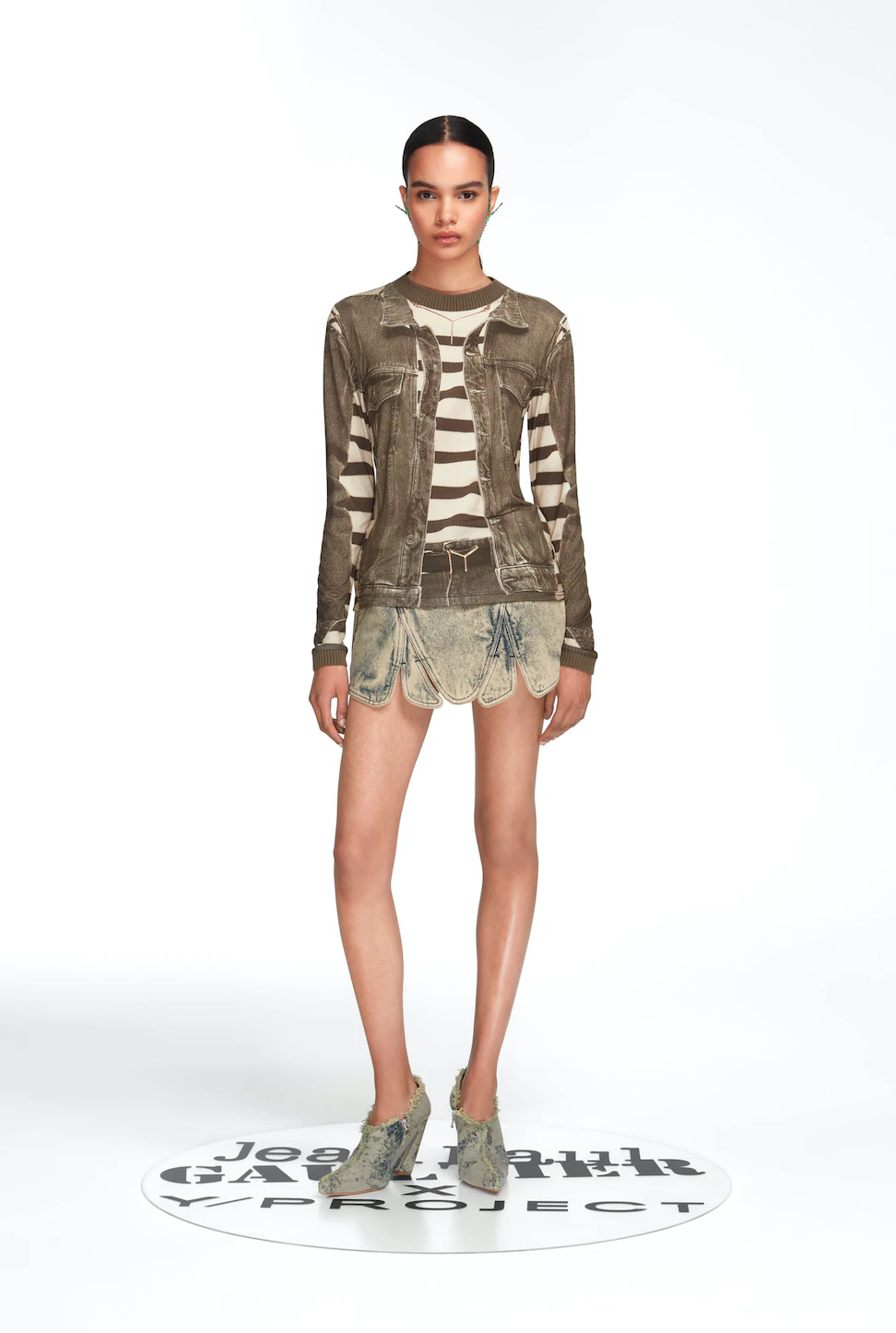
That influence is now visible in two directions at once: in the many designers — from Rousteing to Lantink — who cite him directly as a formative inspiration, and in the house’s own ongoing reinvention, which treats his 50-year archive not as something to be preserved under glass, but as a living wardrobe to keep reworking. Few fashion houses have handled a founder’s retirement this openly experimental, and the outcome of that experiment is still being written in real time.
It’s also worth noting the legacy isn’t uncomplicated. Gaultier’s habit of pulling freely from other cultures’ dress — Hasidic religious attire in his 1993 “Chic Rabbis” collection is the most-cited example — has drawn criticism over the years as cultural appropriation rather than tribute, even when intended affectionately. And commercially, fragrances have long done more heavy lifting than the runway: Puig’s decision to keep the house couture-only for a decade after 2014, and its cautious, staged return to ready-to-wear under Lantink, reflects a recognition that reviving a full clothing business is a far riskier bet than the perfume counters that reliably keep the Gaultier name profitable.
Frequently Asked Questions
Is Jean-Paul Gaultier still designing?
No. He retired from active design duties following his final haute couture show in January 2020, though he remains involved with the house as its founder and continues public appearances, interviews, and front-row attendance at Gaultier shows.
Who runs Jean Paul Gaultier today?
Dutch designer Duran Lantink has been the house’s permanent creative director since April 2025, overseeing both ready-to-wear and haute couture — the first person to hold that combined role since Gaultier’s own departure.
What happened to the “guest designer” system?
Between 2020 and 2025, eight different designers — including Chitose Abe, Olivier Rousteing, Haider Ackermann, and Simone Rocha — each designed one haute couture collection for the house. That rotating format ended when Lantink was named permanent creative director in 2025.
Does Jean Paul Gaultier still make ready-to-wear?
Yes, as of September 2025. The ready-to-wear line, closed since 2014, was revived under Lantink with his debut “Junior” collection for Spring/Summer 2026.
What is Gaultier best known for?
Madonna’s cone-bra corset from the 1990 Blond Ambition tour is his most widely recognized single design, though his broader legacy rests on popularizing the marinière in menswear, corsetry as outerwear, skirts for men, and gender-fluid tailoring generally.
Who owns Jean Paul Gaultier, and does the fragrance business matter more than the clothes?
The Spanish beauty and fashion group Puig has held a majority stake in the fashion house since 2011 and later took full ownership of its fragrance business. Perfumes such as Classique and Le Male have long been the house’s most consistent commercial engine — arguably more central to its bottom line, day to day, than either the couture or the recently revived ready-to-wear line.
A note on sources: this overview draws on reporting from outlets including WWD, Business of Fashion, Vogue Business, Dazed, Numéro, and the house’s own statements, alongside Wikipedia and Britannica for core biographical facts.
Conclusion of Jean-Paul Gaultier’s work and legacy.
Jean-Paul Gaultier’s path from a working-class Parisian suburb to the top of French fashion — and his decision to hand his house to a rotating cast of successors, and finally to a permanent one in Duran Lantink — is a rare example of a founder actively shaping how his legacy would evolve after his own departure. To go deeper into his work and the house’s current chapter, consider the following:
- Visit the official website: Jean Paul Gaultier’s official site for current collections, including Duran Lantink’s work for the house.
- Follow the house’s current runway seasons: Lantink’s haute couture debut is scheduled for Paris Couture Week, 6–9 July 2026 — a useful moment to see how the archive is being reinterpreted for a new generation. Runway show archives are also tracked here.
- Research specific eras of the archive, such as the “Boy Toy” collection (1983), “Les Tatouages” (Spring/Summer 1994), or the guest-designer haute couture seasons (2020–2025), to see how different creative voices have approached the same house codes.
- Watch documentaries and read further: The Fashion World of Jean Paul Gaultier: From the Sidewalk to the Catwalk (exhibition catalogue) and Jean Paul Gaultier: Freak & Chic offer deeper looks at his career.
- Follow the house on social media: @jeanpaulgaultier on Instagram is the most active channel for current collections; Gaultier himself has also long posted on Twitter/X.
By exploring these resources, you’ll get a fuller picture not just of Gaultier’s own 50-year body of work, but of how a fashion house built entirely around one designer’s irreverence is now navigating life after its founder — a question few of his peers have had to answer so publicly.
All house images are from the official site of Jean-Paul Gaultier.
Resources and Further Reading
Official and Primary Sources
- Official Website: Jean Paul Gaultier — Current collections, Duran Lantink’s work, archives, and news.
- Jean Paul Gaultier Instagram: @jeanpaulgaultier — Runway shows, behind-the-scenes, and updates.
- Jean Paul Gaultier on X/Twitter: @jpgaultier
Books and Catalogues
- The Fashion World of Jean Paul Gaultier: From the Sidewalk to the Catwalk (exhibition catalogue, 2011–2018) — Comprehensive retrospective with essays and imagery.
- Jean Paul Gaultier by Farid Chenoune and others (various monographs available via publishers like Assouline or Thames & Hudson).
Documentaries and Films
- Jean Paul Gaultier: Freak & Chic (2018) — Insightful documentary on his career.
- The Fashion World of Jean Paul Gaultier exhibition documentary (Eurochannel).
- Runway archives and show videos on YouTube (search “Jean Paul Gaultier Couture” or specific collections).
Exhibitions and Retrospectives
- “The Fashion World of Jean Paul Gaultier: From the Sidewalk to the Catwalk” (2011–2018 tour: Montreal, New York, Brooklyn Museum, London Barbican, Paris Grand Palais, etc.) — Drew over a million visitors.
Key Articles and References
- Wikipedia: Jean Paul Gaultier — Detailed timeline and references.
- Britannica: Jean-Paul Gaultier Biography — Concise overview.
- Vogue and WWD coverage of Duran Lantink’s collections (SS26 “Junior” and AW26, 2025–2026).
- Business of Fashion (BoF) and other industry reports on the house’s transition and Puig ownership.
Additional Exploration
- Runway Archives: Vogue Runway or official brand site for past collections (e.g., “Boy Toy” 1983, “Les Tatouages” 1994, guest designer seasons).
- Fragrance History: Official notes on Classique (1993) and Le Male (1995).
- Costume Work: Search for Gaultier’s contributions to The Fifth Element, Madonna tours, and Almodóvar films.

Pashalis Laoutaris
I am a professional writer, fashion blogger, and the owner of https://laoutaris.com. I have over 20 years of experience as a salesperson and 10 years of experience as a fashionista. I write daily blog articles about fashion, tools, converters, and everything you need to know about current trends.Laoutaris Recommends