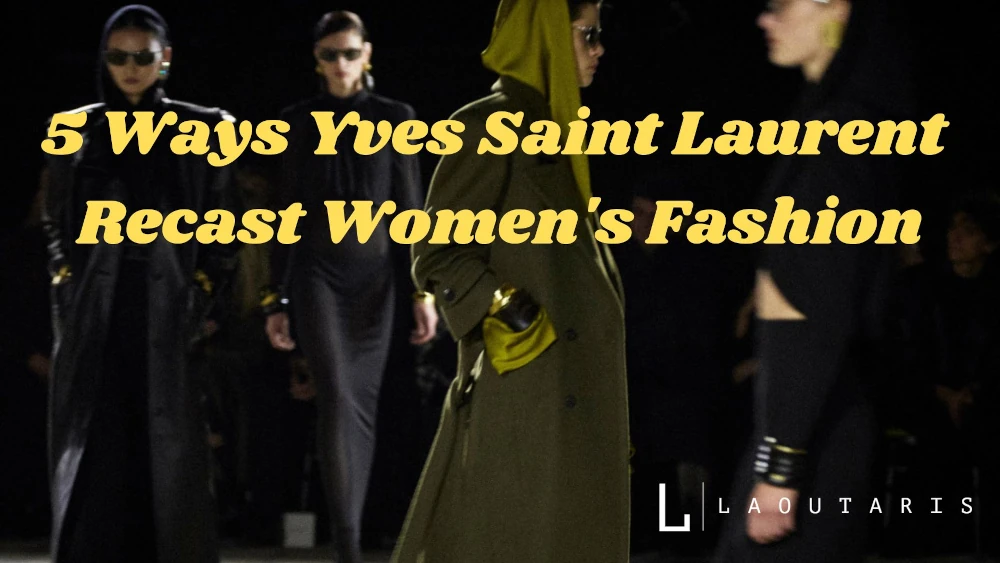
Yves Saint Laurent spent barely four decades behind a sketchbook, yet almost everything a modern woman owns — a tuxedo, a trench, a pantsuit, a safari jacket — carries his fingerprints.
Nearly two decades after his death, his own house still leans on that inheritance: creative director Anthony Vaccarello returns to Le Smoking and the safari jacket almost every season.
This is a fact-checked, source-linked look at Saint Laurent’s life, his most consequential designs, the controversies that trailed him, and the institutions that keep his archive alive today, including one major change: his Paris museum is currently closed for renovation.
Table of Contents
The average reading time is 11 minutes. The article was last updated on 05/07/2026.
Quick Facts
| Fact | Detail | Source |
|---|---|---|
| Full birth name | Yves Henri Donat Mathieu-Saint-Laurent | Britannica |
| Born | August 1, 1936, in Oran, French Algeria | Musée Yves Saint Laurent Paris |
| Died | June 1, 2008, in Paris, of brain cancer, aged 71 | Wikipedia |
| Fashion house founded | 1961 (with Pierre Bergé); debut Spring/Summer 1962 collection shown January 29, 1962 | Musée Yves Saint Laurent Paris |
| Business and life partner | Pierre Bergé (met 1958; romantic partnership ended 1976; business partnership lasted until Saint Laurent’s death) | Social Life Magazine |
| Signature invention | “Le Smoking,” the tuxedo suit for women, 1966 | Musée Yves Saint Laurent Paris |
| Retirement | Announced January 7, 2002; final runway retrospective January 22, 2002 | The New York Times |
| Highest honor | Grand Officier de la Légion d’honneur, 2007 | Wikipedia |
| Ashes scattered | Jardin Majorelle, Marrakech, Morocco | Wikipedia |
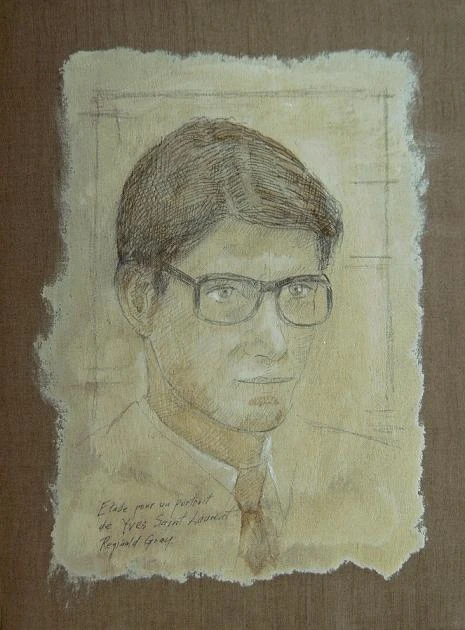
Early Life: Oran to Paris
Saint Laurent was born on August 1, 1936, at the Jarsaillon Clinic in Oran, then part of French Algeria. His parents were Charles Mathieu-Saint-Laurent, an insurance executive and cinema-chain owner, and Lucienne Andrée Mathieu-Saint-Laurent. He had two younger sisters, Michèle and Brigitte. The family grew up in a seaside villa with a full domestic staff and summered in Trouville, on the Normandy coast — a comfortable, socially prominent upbringing that shaped his early tastes (Musée Yves Saint Laurent Paris).
He was a shy, bookish child who was bullied at his strict Catholic school for seeming effeminate, and who found refuge in his mother’s fashion magazines and in amateur theater. A 1950 school trip to see a Molière production designed by Christian Bérard is often cited as a formative artistic jolt (Musée Yves Saint Laurent Paris). By his teens, he was sketching dresses for his mother and sisters and building elaborate paper-doll theaters at home.
Key early milestones:
- 1953–54 — At 17, he travels to Paris and is introduced to Michel de Brunhoff, editor-in-chief of French Vogue, who encourages him to formally study fashion (EBSCO Research Starters).
- 1954 — Enrolls at the École de la Chambre Syndicale de la Haute Couture in Paris and graduates at the top of his class.
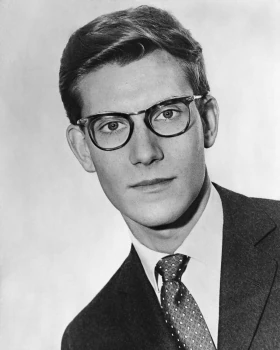
- 1955 — Wins first prize in the International Wool Secretariat design competition, beating fellow entrants Karl Lagerfeld and Fernando Sánchez. De Brunhoff notices that his winning sketches closely resemble ones Christian Dior had shown him that same morning, and sends the 18-year-old to meet Dior directly, who hires him on the spot (Wikipedia).
The Dior Years (1955–1960)
Saint Laurent worked as Dior’s assistant for two years before an abrupt promotion. When Christian Dior died suddenly of a heart attack in October 1957, the 21-year-old Saint Laurent was named artistic director of the House of Dior — putting him, almost overnight, in charge of what was then the most prestigious couture house in the world (Britannica).
His debut collection for Dior, the Trapèze line (spring 1958), moved away from Dior’s structured “New Look” toward dresses that flared gently from the shoulder, and was a critical and commercial triumph that was credited with saving the house (EBSCO Research Starters). In 1959, he designed the wedding dress worn by Farah Diba for her marriage to the Shah of Iran, Mohammad Reza Pahlavi. His riskier 1960 “Beat” collection — leather jackets, turtlenecks, a look borrowed from Left Bank beatniks — was poorly received by the conservative Dior clientele.
That same year, Saint Laurent was conscripted into the French army during the Algerian War of Independence. Twenty days into service, the stress of military hazing led to a psychological collapse; he was hospitalized and, while there, learned that Dior’s board had replaced him with designer Marc Bohan. He was transferred to Val-de-Grâce military hospital, where he was treated with heavy sedatives, psychoactive drugs, and electroshock therapy — treatment he later said triggered both his lifelong mental-health struggles and his drug dependency (Wikipedia). Released in November 1960, he sued Dior for breach of contract and won roughly $140,000 in damages (EBSCO Research Starters).
Founding His Own House (1961–1962)
With the Dior settlement and financing from American industrialist J. Mack Robinson and cosmetics firm Charles of the Ritz, Saint Laurent and his partner Pierre Bergé — whom he had met in 1958 — opened their own couture house.
| Date | Event | Source |
|---|---|---|
| Fall 1961 | Yves Saint Laurent house is legally established with Bergé | Wikipedia |
| December 4, 1961 | The atelier at 11 Rue Jean-Goujon opens its doors; the first gown (“00001”) is delivered to society figure Patricia Lopez-Willshaw | Musée Yves Saint Laurent Paris |
| January 29, 1962 | The debut Spring/Summer 1962 collection is shown at 30bis Rue Spontini, Paris, to a standing ovation | Social Life Magazine |
| 1963 | House logo designed by graphic artist A. M. Cassandre. | Wikipedia |
| 1966 | Rive Gauche, the first ready-to-wear boutique to carry a couturier’s own name, opens on Rue de Tournon. | Musée Yves Saint Laurent Marrakech |
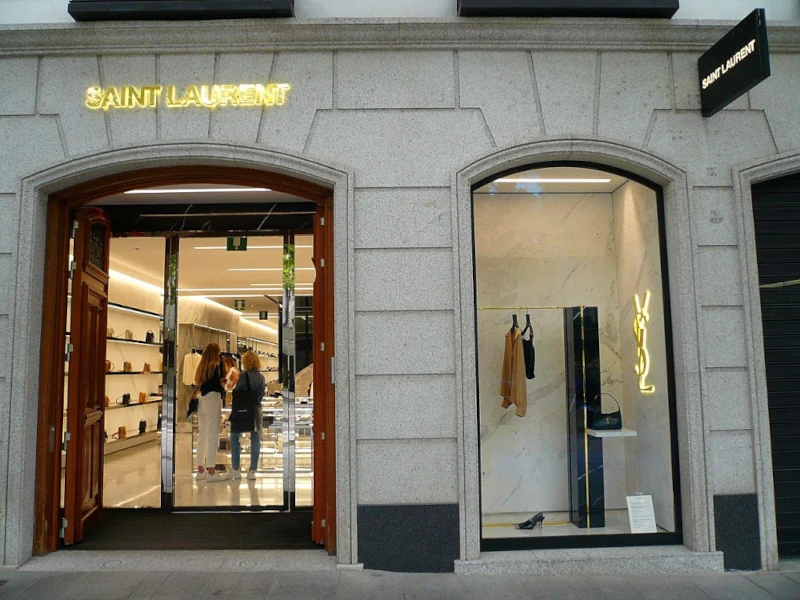
| 1974 | The house relocates to 5 Avenue Marceau, which now houses the Musée Yves Saint Laurent Paris. | Musée Yves Saint Laurent Marrakech |
Bergé ran the business side for the rest of Saint Laurent’s career: financing, licensing, and legal battles. Their romantic relationship ended in 1976, but they remained business partners and close friends for the following three decades (Social Life Magazine).
The Revolutionary Designs
Saint Laurent’s most influential contribution was making menswear tailoring available — and desirable — to women, without abandoning femininity. The table below fact-checks the dates most often (and often incorrectly) attached to his best-known pieces.
| Design | Year introduced | Notes | Source |
|---|---|---|---|
| Trapèze line (for Dior) | Spring 1958 | His Dior debut; softened Dior’s “New Look” silhouette. | Britannica |
| Pea coat & fisherman’s smock | Fall 1962 | From his second collection under his own name. | Wikipedia |
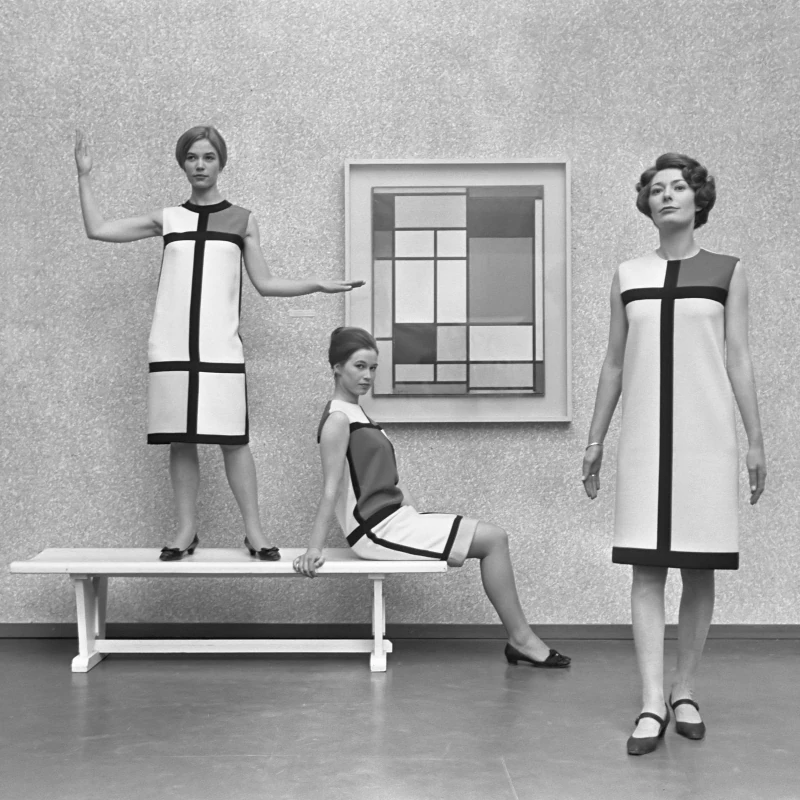
| Mondrian collection | Autumn/Winter 1965, presented August 6, 1965 | Six shift dresses (out of 106 looks) referencing Piet Mondrian’s color-block paintings; widely copied by mass manufacturers within months. | Musée Yves Saint Laurent Paris |
| Le Smoking (women’s tuxedo) | Autumn/Winter 1966 | His most enduring design; photographed by Helmut Newton for French Vogue in 1975. | Musée Yves Saint Laurent Paris |
| Rive Gauche ready-to-wear line | 1966 | First haute couture designer to put his own name on a ready-to-wear boutique. | Musée Yves Saint Laurent Marrakech |
| Pioneering women’s tailoring/pantsuits | Around 1967 | Sources generally group the first true pantsuit with the following year’s safari jacket, so treat 1967–68 as a single stretch of tailoring experiments rather than one exact date. | Musée Yves Saint Laurent Marrakech |
| Safari jacket | Spring/Summer 1968 haute couture; ready-to-wear version 1969 | Inspired by Afrika Korps uniforms and Western dress in colonial Africa. | Musée Yves Saint Laurent Paris |
| Jumpsuit | Spring/Summer 1968 | Shown the same season as the safari jacket. | Musée Yves Saint Laurent Paris |
| Sheer/see-through blouses | Late 1960s | Models wore them braless; caused scandal at the time. | Dazed |
| “Opium” fragrance | 1977 | See the Controversies section below. | Musée Yves Saint Laurent Paris |
Note on the “Mondrian dress”: there wasn’t a single dress but a six-piece collection of shift dresses in geometric color blocks. It was presented on August 6, 1965, as part of a 106-look Autumn/Winter 1965 show, and was directly inspired by Dutch painter Piet Mondrian’s compositions. It was copied so widely by cheaper manufacturers within weeks of its debut that it became one of the most bootlegged designs of the decade (Musée Yves Saint Laurent Paris).
Le Smoking: The Tuxedo for Women
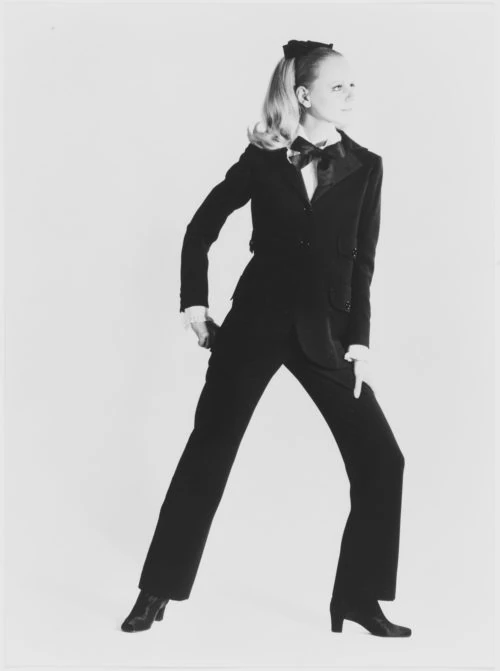
“Le Smoking” debuted in Saint Laurent’s Autumn/Winter 1966 collection: a woman’s tuxedo, complete with satin lapels and a bow tie, styled to be worn as evening wear rather than costume. It was not universally welcomed — several society women who wore it were reportedly turned away from restaurants and hotels in New York and London in the following years, an anecdote repeated in multiple Saint Laurent obituaries (Legacy.com obituary via Associated Press).
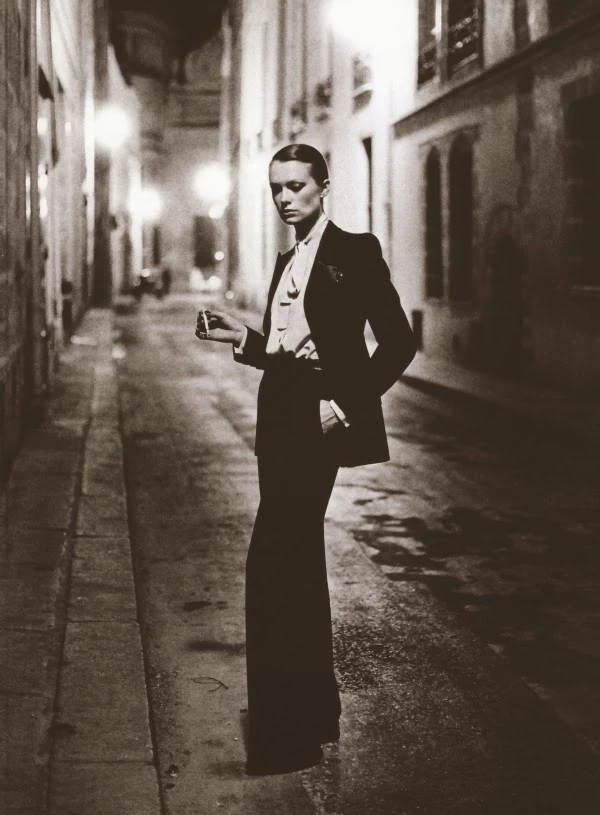
Helmut Newton’s 1975 photograph of a model in Le Smoking for French Vogue, shot on a Paris street at night, became one of the most reproduced fashion photographs of the 20th century and cemented the design’s status (Social Life Magazine). You can see an original Le Smoking piece documented by the Musée Yves Saint Laurent Paris.
Borrowing From Menswear, Season After Season
Le Smoking was the opening move in a much longer pattern. Across the late 1960s, Saint Laurent repeatedly took garments coded as masculine — the safari jacket, the trench coat, the pea coat, the jumpsuit — and re-cut them for women, usually with a fitted waist or a sheer panel that kept the silhouette unmistakably feminine. Contemporary designers continue to reference this playbook; Saint Laurent’s own successors at the house, from Hedi Slimane to current creative director Anthony Vaccarello, still return to the tuxedo and the safari jacket in their collections (Wikipedia).
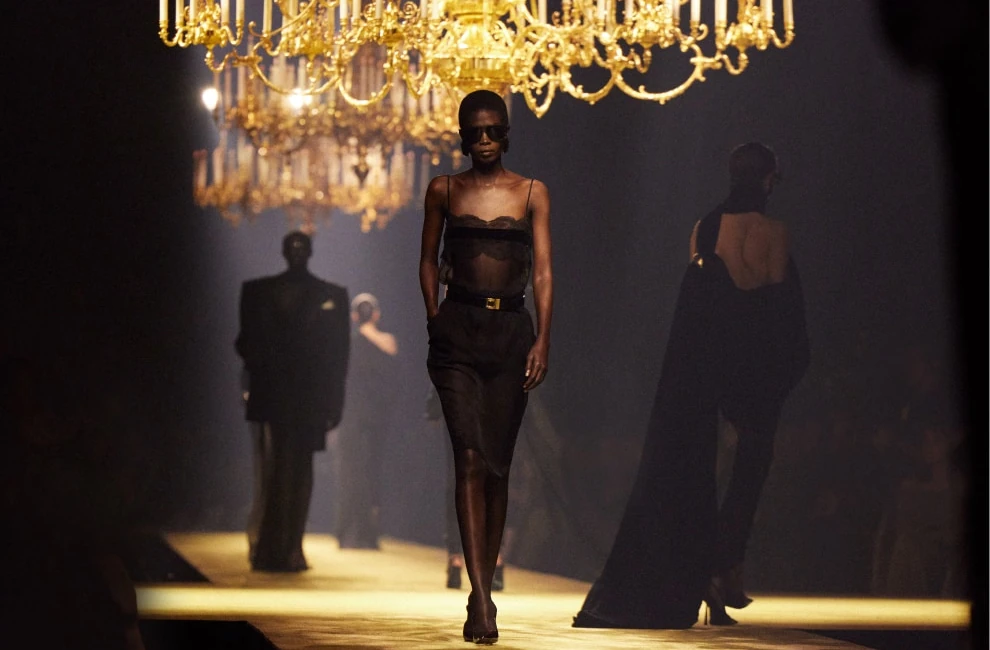
Current collections from the house are shown on ysl.com.
Art on the Runway
Saint Laurent treated painting as a direct source of raw material rather than loose inspiration. Beyond the 1965 Mondrian dresses, he built collections around Vincent van Gogh (1988, with beaded jackets referencing Irises and Sunflowers), Pablo Picasso, Henri Matisse, and Georges Braque, and he collected art seriously throughout his life. After his death, the art collection he and Bergé had assembled was auctioned in Paris in 2009 for more than $260 million — a record at the time for a private collection (Britannica).
Morocco and a More Diverse Runway
Saint Laurent and Bergé made their first trip to Marrakech in 1966 and returned repeatedly for the rest of Saint Laurent’s life; he later said, “Everything was black before Marrakech,” crediting the city’s color palette with reshaping his work (Wikipedia). In 1980, he and Bergé bought the Jardin Majorelle, a botanical garden created by French painter Jacques Majorelle, to save it from being redeveloped into a hotel, and restored it as a private retreat that is now open to the public.
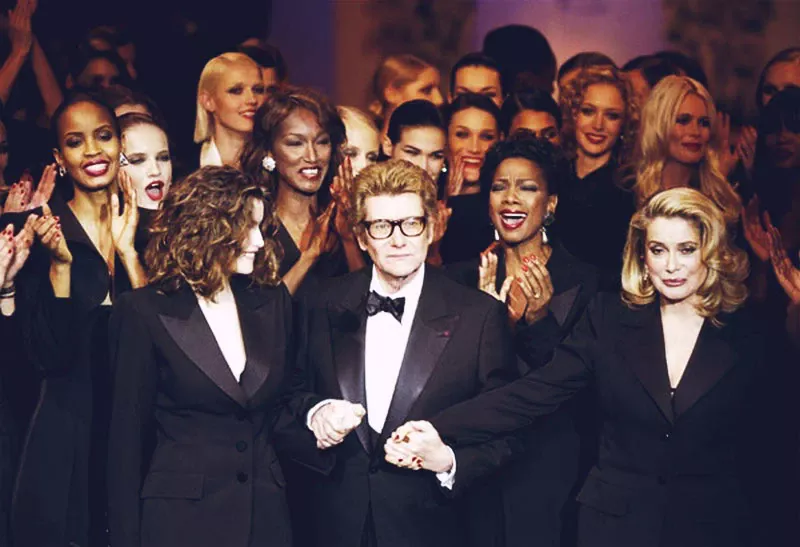
Saint Laurent is also widely credited, alongside designer Paco Rabanne, as one of the first couturiers to regularly cast Black models on a European runway. A model known as Fidelia is generally cited as the first Black woman to walk a Saint Laurent show; later muses included Rebecca Ayoko, Mounia Orosemane, Katoucha Niane, and Amalia Vairelli (Deeds Magazine; Musée Yves Saint Laurent Paris). His Autumn/Winter 1978 haute couture collection was built around Martinique-born model Mounia and was directly inspired by Gershwin’s Porgy and Bess (Essence). Naomi Campbell has said Saint Laurent personally intervened to secure her first French Vogue cover after the magazine initially resisted putting a Black model on it (Dazed).
| Model | Association with Saint Laurent | Source |
|---|---|---|
| Victoire Doutreleau | His favorite model during the Dior years, from 1955 | Musée Yves Saint Laurent Paris |
| Fidelia | Widely cited as the first Black model to walk a Saint Laurent runway | Doria Adoukè |
| Mounia Orosemane | House muse from 1978; anchor of the Porgy and Bess-inspired A/W 1978 collection | Essence |
| Rebecca Ayoko | Runway and campaign muse through the late 1970s–80s | WWD |
| Katoucha Niane | Became the face of the house, succeeding Ayoko | Deeds Magazine |
| Naomi Campbell | Credits Saint Laurent with securing her first French Vogue cover | Dazed |
Controversies and Criticism
The Opium Fragrance
In 1977, to coincide with an Autumn/Winter collection inspired by China, Saint Laurent launched a women’s fragrance called Opium, styled with a lacquered bottle recalling a Japanese inro case and advertised with a Helmut Newton photograph of model Jerry Hall reclining before a gilded Buddha statue (Musée Yves Saint Laurent Paris).
| Event | Detail | Source |
|---|---|---|
| 1977 | European launch; the name draws immediate accusations of glamorizing drug addiction | Opium (perfume), Wikipedia |
| 1977–78 | Banned in Australia; its name is prohibited in parts of the Middle East. A group calling itself the American Coalition Against Opium and Drug Abuse forms in protest, arguing the name trivialized a drug that had devastated Chinese communities | The Rake |
| September 1978 | North American launch party held aboard the tall ship Peking in New York Harbor, with roughly 800 guests including Cher, Diana Vreeland, and Truman Capote | 29Secrets |
| First year | Despite (or because of) the controversy, European sales alone reach roughly $30 million | Musée Yves Saint Laurent Paris |
| 2000 | A new advertising campaign featuring a nude Sophie Dahl draws more than 700 complaints in the UK and is withdrawn by the Advertising Standards Authority for being overtly sexual | Opium (perfume), Wikipedia |
Opium remains one of the best-selling fragrances of the 20th century, and the house has repeatedly returned to it, including the 2014 launch of “Black Opium.” Historians of fashion marketing generally frame it as a defining case study in how a genuinely offensive campaign can also be commercially transformative — the scandal was, by most accounts, good for sales even as it was legitimately hurtful to the groups it referenced (South China Morning Post).
Legacy: Honors, Sales, and Museums
Honors and awards
| Year | Honor | Source |
|---|---|---|
| 1982 | International Fashion Award, Council of Fashion Designers of America (CFDA) | Wikipedia |
| 1983 | First living fashion designer given a solo retrospective at the Metropolitan Museum of Art, New York | Britannica |
| 1985 | Chevalier de la Légion d’honneur, awarded by President François Mitterrand | Musée Yves Saint Laurent Paris |
| 1999 | Geoffrey Beene Lifetime Achievement Award, CFDA | Wikipedia |
| 2000 | Promoted to Commandeur de la Légion d’honneur | Musée Yves Saint Laurent Paris |
| 2001 | Rank sometimes reported as “Commander” awarded under President Jacques Chirac (see note below) | Wikipedia |
| 2007 | Elevated to Grand Officier de la Légion d’honneur by President Nicolas Sarkozy — the highest honor he received | Britannica |
A note on the Légion d’honneur: sources differ slightly on exact promotion years for the intermediate ranks (Officier and Commandeur), but they agree on the two anchor dates — Chevalier in 1985 and Grand Officier in 2007 — so the original claim that he “received the rank of Commander in 2001” is broadly consistent with the record, even if some accounts place that specific promotion in 2000.
Business milestones
| Year | Event | Source |
|---|---|---|
| 1989 | House goes public on the Paris Stock Exchange, valued at roughly $500 million.n | Luxury Fandom Wiki |
| 1993 | Fragrance and beauty business sold to Elf Sanofi for roughly $650 million | Luxury Fandom Wiki |
| 1999 | Ready-to-wear house acquired by Gucci Group; Tom Ford becomes creative director | Britannica |
| 2002 | Haute couture division closes permanently after Saint Laurent’s retirement | Britannica |
| 2008 | The beauty license, YSL Beauty, passes to L’Oréal | Wikipedia |
| 2016–present | Anthony Vaccarello serves as creative director of the house | Wikipedia |
| 2024 | The house reports €2.9 billion in annual sales | Wikipedia |
Museums — updated status:
| Institution | Status as of mid-2026 | Source |
|---|---|---|
| Musée Yves Saint Laurent Paris | Closed for renovation since May 5, 2025; scheduled to reopen autumn 2027 with double the exhibition space and a new documentation center | Musée Yves Saint Laurent Paris |
| Musée Yves Saint Laurent Marrakech | Open; opened October 19, 2017 | Wikipedia |
| Jardin Majorelle | Open; the botanical garden Saint Laurent and Bergé saved from redevelopment in 1980 | Wikipedia |
| “Yves Saint Laurent and Photography” | A traveling exhibition standing in for the closed Paris museum; opened at the Rencontres d’Arles in 2025, later traveled to the International Center of Photography in New York | ICP |
If you’re planning a trip built around Saint Laurent’s legacy right now, Marrakech — not Paris — is the more complete stop until the Paris museum reopens in 2027.
The House Today
The commercial brand has evolved well beyond its founder, but it still leans on his archive rather than replacing it. Anthony Vaccarello, creative director since 2016, moved the ready-to-wear design studio to Los Angeles while keeping the couture atelier in France, revived the dormant haute couture line in 2015 under his predecessor Hedi Slimane, and dropped “Yves” from the ready-to-wear label to create a harder-edged, contemporary “Saint Laurent” — while the original “Yves Saint Laurent” name and monogram logo were kept for accessories and the L’Oréal-owned beauty line (Wikipedia).

Cédric Charbit became CEO in 2024, and in April 2023 the house launched Saint Laurent Productions, an arthouse film unit whose first releases were short films by Pedro Almodóvar and Jean-Luc Godard, with costumes designed by Vaccarello (Wikipedia). Even as the business has modernized, the founder’s own archive — administered separately by the Fondation Pierre Bergé–Yves Saint Laurent — remains the reference point every new creative director is measured against.
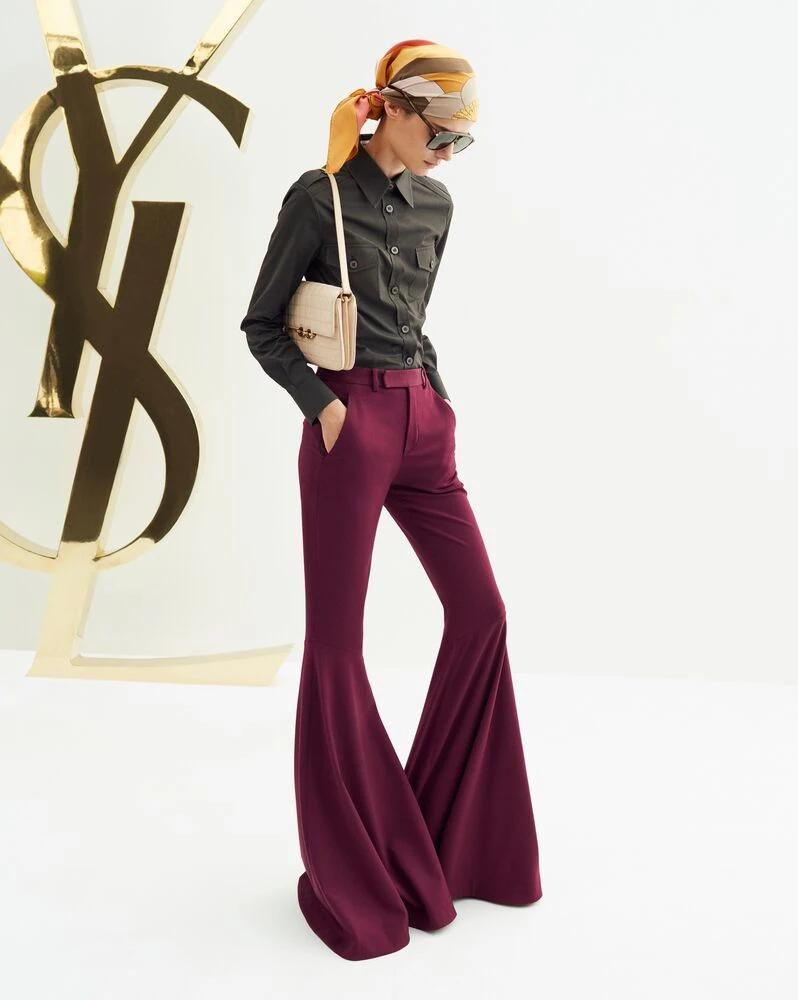
Saint Laurent’s core claim about his own career — that he built “the modern woman’s wardrobe” — is one that fashion historians generally accept rather than dispute. Fashion historian Caroline Rennolds Milbank called him, in her 1985 book Couture: The Great Fashion Designers, “the most consistently celebrated and influential designer of the past twenty-five years” for both reviving 1960s couture and legitimizing ready-to-wear (cited in Wikipedia).
Frequently Asked Questions
Who was Yves Saint Laurent?
A French couturier, born in Oran, Algeria, in 1936, who became head designer of Christian Dior at 21 and later founded his own house in 1961. He is credited with popularizing the women’s tuxedo, the pantsuit, and the safari jacket, and with making ready-to-wear a respected part of haute couture. He died in 2008 (Britannica).
What was Yves Saint Laurent’s signature style?
A fusion of couture-level construction with menswear tailoring, applied to womenswear — most famously in “Le Smoking,” the 1966 women’s tuxedo suit (Musée Yves Saint Laurent Paris).
What are some of Yves Saint Laurent’s most iconic designs?
The Mondrian shift dresses (1965), Le Smoking (1966), the safari jacket and first women’s pantsuit (1967–68), the jumpsuit (1968), and the Rive Gauche ready-to-wear line launched in 1966 (Wikipedia).
What is Yves Saint Laurent’s contribution to women’s wear?
Yves Saint Laurent is credited with revolutionizing women’s wear in the 20th century by introducing new styles and designs that broke away from traditional feminine norms. His pioneering techniques included pantsuits, tuxedos, and short skirts, which are still popular today.
Is the Yves Saint Laurent museum in Paris open right now?
No — it closed on May 5, 2025, for a major renovation and is scheduled to reopen in autumn 2027. The Marrakech museum and the Jardin Majorelle remain open in the meantime (Musée Yves Saint Laurent Paris).
Where can I see Saint Laurent’s work in person today?
Three options, ranked by completeness while the Paris museum is closed: the Musée Yves Saint Laurent Marrakech, which holds thousands of garments and accessories curated by Bergé himself (Musée Yves Saint Laurent Marrakech); the adjoining Jardin Majorelle, the botanical garden Saint Laurent and Bergé restored and where his ashes were scattered (Jardin Majorelle); and the traveling exhibition “Yves Saint Laurent and Photography,” which originated at the Rencontres d’Arles in 2025 and has since traveled to the International Center of Photography in New York (ICP). The Paris museum, with the largest single collection, reopens in autumn 2027.
What is Yves Saint Laurent’s contribution to women’s wear?
He is widely credited with dismantling the idea that tailoring, trousers, and menswear fabrics belonged only to men’s fashion, and with being among the first couturiers to build a real ready-to-wear business under his own name (EBSCO Research Starters).
Was Yves Saint Laurent involved in any controversies?
Yes. The 1977 Opium fragrance was accused of trivializing drug addiction and of appropriating Chinese cultural and religious imagery for marketing purposes, sparking boycotts and, eventually, an outright ban on the name in some countries. A separate 2000 Opium ad campaign featuring a nude Sophie Dahl drew hundreds of complaints in the UK and was withdrawn (Opium (perfume), Wikipedia).
Are Yves Saint Laurent’s designs still relevant today?
Yes — the house he founded, now known simply as Saint Laurent under creative director Anthony Vaccarello, reported €2.9 billion in sales in 2024, and continues to revisit Le Smoking and the safari jacket in its collections (Wikipedia).
Conclusion
Strip away the mythology and the record still holds up: a designer who took over one of the world’s biggest fashion houses at 21, was fired at 24, sued and won, and then spent the next forty years methodically moving menswear tailoring into the female wardrobe — while also making genuine, documented efforts toward racial diversity on overwhelmingly white runways.
None of that erases the real harm of a marketing campaign like Opium’s, or the personal cost of his own addiction and mental illness. Both things are part of the same, thoroughly documented life. The clearest way to see it firsthand right now is in Marrakech, at the Jardin Majorelle and the Musée Yves Saint Laurent Marrakech — Paris reopens in 2027.

Pashalis Laoutaris
I am a professional writer, fashion blogger, and the owner of https://laoutaris.com. I have over 20 years of experience as a salesperson and 10 years of experience as a fashionista. I write daily blog articles about fashion, tools, converters, and everything you need to know about current trends.Laoutaris Recommends