
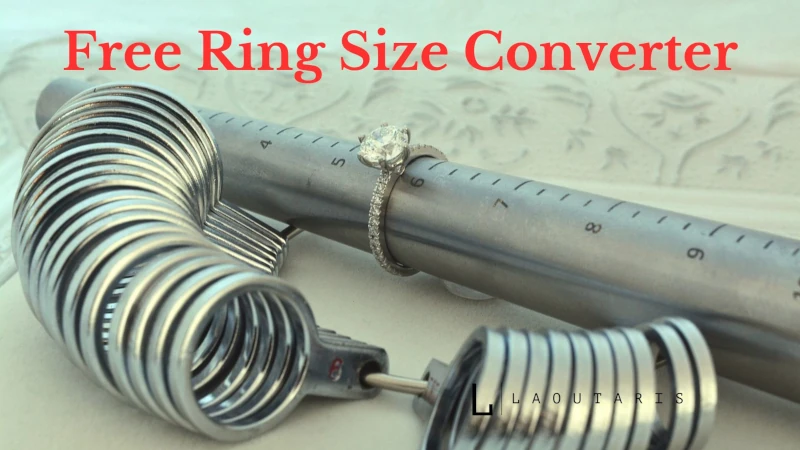
Convert your ring size instantly between the US, UK, Germany, France, Italy, Japan, China, and India — no charts to hunt through.
Did you know? You can avoid up to 30% of online jewelry returns simply by getting the right size the first time.
Table of Contents
The article was last updated on 06/07/2026
How to use our ring size converter
Type in your ring’s inner diameter — in millimeters or inches — and every major sizing system updates at once: US & Canada, UK & Australia, Germany, France/Italy/Spain/Switzerland, Japan/China/Korea, and India. No diameter handy? Enter the circumference instead, or convert straight from a size you already know in any of those systems.
The diameter in millimeters is the one measurement that means the same thing everywhere — sizes labeled “6,” “M,” or “54” only make sense within their own country’s system, so converting through the physical measurement avoids the guesswork.
Ring Size Converter
Enter your ring’s inner diameter or circumference and see the matching size across every major sizing system at once — no more guessing which column applies to which country.
See the full reference table (diameter 11.6 mm – 24.6 mm)
| Diameter mm | Circumf. mm | US/CA | UK/AU/IE/NZ | Germany | FR/IT/ES/CH | JP/CN/KR | India |
|---|
Based on ISO 8653:2016, BS EN 28653:1993, and JIS S 4700:2022 sizing standards. Note that a manufacturing tolerance of ±0.1–0.2 mm is normal. Ring sizing conventions vary slightly by manufacturer, so treat this as a strong estimate rather than a guarantee — when it matters (engagement rings, gifts), confirm with a jeweler’s sizing tool before ordering.
How to measure your ring diameter at home
You have three practical options, roughly in order of accuracy:
Measure a ring that already fits. Lay it flat on a ruler or a printed millimeter grid and measure straight across the inside of the band — that's the inner diameter. This is the most reliable at-home method because a rigid ring doesn't stretch or distort the way string or paper can.
Wrap a strip of paper around your finger. A snug (not tight) strip of paper holds its shape better than string. Mark where it overlaps, measure that length flat against a ruler in millimeters, and enter it into the converter as circumference — it'll calculate the diameter for you.
Use a printed ring sizer. Many sizing charts are available to print for free; the critical step is printing at 100% scale with any "fit to page" scaling turned off, then checking it against a ring you own or against your finger directly.
If you'd rather skip measuring altogether, a physical ring sizing mandrel gives you a definitive answer and is worth owning if you size rings often.
Why every country uses a different ring size system
There's no single global ring size standard, which is why a size "7" means something completely different depending on where you're shopping. Here is a quick comparison of how the base formulas differ:
| Country/Region | Base Measurement System | General Formula / Step Size |
|---|---|---|
| US & Canada | Inches | Size = (Diameter in inches - 0.458) ÷ 0.032 |
| UK & Australia | Circumference (mm) | Alphabetical scale; each letter is a 1.25 mm step in circumference |
| Germany | Inner Diameter (mm) | Direct diameter measurement (e.g., 17.5 mm = Size 17.5) |
| France / EU | Circumference (mm) | Size = Circumference in mm - 40 |
| Japan / China / Korea | Arbitrary Numeric | Lookup-based, approx 1/3 mm diameter steps |
| India | Arbitrary Numeric | Lookup-based, unique local scale |
Because these systems don't share a formula, converting size-label to size-label directly can compound rounding errors. Going through the physical diameter, as this tool does, keeps the conversion accurate.
Getting an accurate size: timing, temperature, and band width
A ring size isn't a fixed number the way a shoe size roughly is — fingers change size throughout the day and with the weather.
- Measure in the evening. Fingers are typically smaller in the morning and swell slightly by the end of the day, so an evening measurement gives you a more realistic everyday fit.
- Avoid measuring right after exercise, in the cold, or right after a salty meal. Temperature and fluid retention both shift finger size temporarily.
- Wide bands need a size up. A band 6mm or wider contacts more of your finger than a thin band, so it typically feels tighter at the same labeled size. If you're ordering a wide band, size up half a size from your measured diameter.
- When between two sizes, round up. It's far easier for a jeweler to size a ring down than up.
How to find the ring diameter
If you can not measure the diameter, you can measure the circumference and use the table below to find the correct diameter value.
| Circumference (mm) | Diameter (mm) |
|---|---|
| 36.5 | 11.63 |
| 37.8 | 12.04 |
| 39.1 | 12.45 |
| 40.4 | 12.85 |
| 41.7 | 13.26 |
| 42.9 | 13.67 |
| 44.2 | 14.07 |
| 45.5 | 14.48 |
| 46.8 | 14.88 |
| 48.0 | 15.29 |
| 49.3 | 15.70 |
| 50.6 | 16.10 |
| 51.9 | 16.51 |
| 53.1 | 16.92 |
| 54.4 | 17.32 |
| 55.7 | 17.53 |
| 57.0 | 18.14 |
| 58.2 | 18.54 |
| 59.5 | 18.95 |
| 60.8 | 19.35 |
| 62.1 | 19.76 |
| 63.4 | 20.17 |
| 64.6 | 20.57 |
| 65.9 | 20.98 |
| 67.2 | 21.39 |
| 68.5 | 21.79 |
| 69.7 | 22.20 |
| 71.0 | 22.61 |
| 72.3 | 23.01 |
| 73.6 | 23.42 |
| 74.9 | 23.83 |
| 76.1 | 24.23 |
| 77.4 | 24.64 |
Ring size tools
There are many ring-size tools on the market. You can even make your own from paper. But the more professional ones are made from aluminum and will last forever.
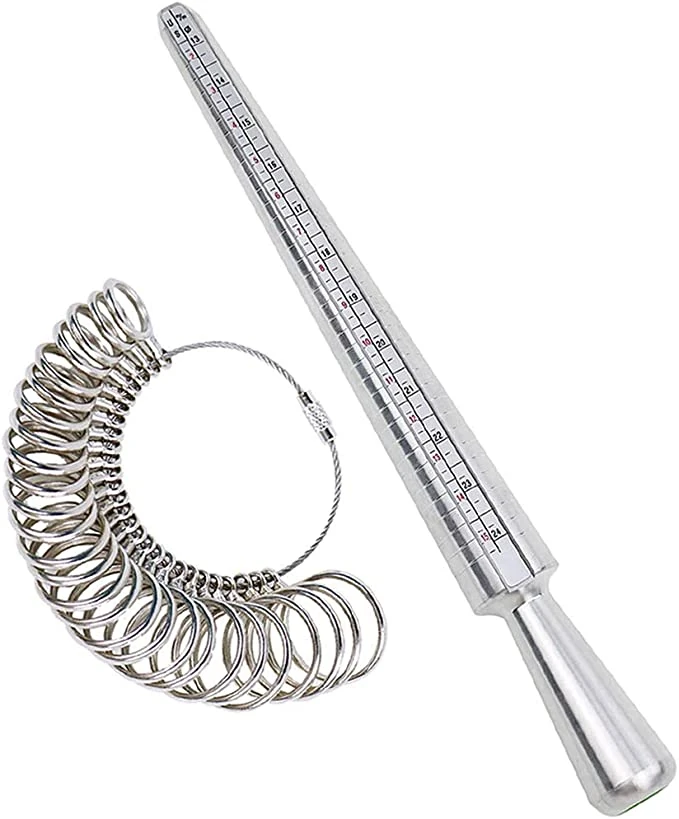
Check the above at Amazon.com.
Frequently Asked Questions
How often should I measure my ring size?
Periodically, especially around big changes in weight, climate, or season — the same finger can measure differently in July than in January. If it's been a year or more since you last measured, it's worth double-checking before ordering anything you can't easily size.
What if I receive a ring that doesn't fit even after using the converter tool?
Contact the seller or jeweler first — most offer a resizing window, and getting it adjusted is usually far cheaper and faster than a return. Keep in mind that a converted size is an estimate of the seller's stated size, not a guarantee of how their specific ring is cut.
I don't know my current ring size. What should I do?
Measure an existing ring that fits the intended finger, or visit a local jeweler for a free sizing — most jewelry counters do this in a couple of minutes with no obligation to buy. Once you have that number, use the converter to translate it anywhere.
Is this tool suitable for all types of rings, including engagement rings and wedding bands?
Our ring size converter tool is designed for various rings, including engagement rings, wedding bands, and other jewelry.
Is this converter accurate for engagement rings and wedding bands specifically?
Yes — the underlying measurement (inner diameter) is the same regardless of ring style. The one adjustment to keep in mind is band width: many engagement ring settings and wedding bands run wider than a plain sizing ring, so consider sizing up if the band is 6mm or more across.
Can I trust the converted size across every brand?
The conversion itself is accurate to the international standards it's based on, but individual manufacturers sometimes cut slightly differently from the standard. For anything expensive or hard to return, cross-check against that specific retailer's own size chart if they publish one.
How accurate is this tool?
It's built from the published ISO 8653:2016, BS EN 28653:1993, and JIS S 4700:2022 sizing standards, which is as accurate as ring sizing gets without a physical mandrel in hand. For sizes that fall between standard measurements, it's precise to a fraction of a millimeter; for a final purchase, especially a gift, we'd still recommend a jeweler check when possible.
How does the converter actually work?
You give it one physical measurement — diameter or circumference, in mm or inches — and it maps that number against each country's published sizing standard simultaneously, rather than making you look up one country, note the diameter, then look that diameter up again in a second chart.
What size for thumb, index, or middle finger?
Your thumb is typically the largest digit, while the ring finger is often the smallest. A good rule of thumb is that the index and middle fingers are usually one to two full sizes larger than your ring finger, but it varies completely by individual.
Are there differences between men's vs. women's ring sizing?
No, ring sizes are unisex. A size 8 is identically sized whether it's classified as a "men's band" or a "women's ring". The main difference is style — men's rings tend to be physically wider (>6mm), meaning you may need to order a half-size up for comfort.
What are the best practices for international shipping & returns?
When buying internationally, always check the jeweler's return policy. Custom, personalized, or engraved rings are almost always final sale. Look for jewelers who offer a "free first resizing" guarantee, which mitigates the risk of ordering the wrong size.

Pashalis Laoutaris
I am a professional writer, fashion blogger, and the owner of https://laoutaris.com. I have over 20 years of experience as a salesperson and 10 years of experience as a fashionista. I write daily blog articles about fashion, tools, converters, and everything you need to know about current trends.Laoutaris Recommends