
On June 7, 2026, at Prada’s SoHo Epicenter store in New York City — a setting far more accustomed to runway shows than rocket science — Axiom Space and Prada pulled back the curtain on the next piece of NASA’s lunar spacesuit puzzle: the Liquid Cooling and Ventilation Garment, or LCVG. The timing wasn’t an accident. Just days later, NASA revealed the crew for Artemis III at Johnson Space Center, putting the whole Artemis program — and the suits astronauts will wear — squarely back in the spotlight.
Here’s the important clarification up front, because it shapes everything that follows: while the buzz around this reveal landed right alongside the Artemis III crew news, the AxEMU spacesuit and its new LCVG inner layer are being developed for Artemis IV — the mission currently slated to put astronauts back on the lunar surface for the first time since Apollo 17 in 1972, this time at the Moon’s South Pole. Artemis III, by contrast, is a crewed mission that won’t include a landing; Axiom has said it’s prepared to test the AxEMU during that mission too, but the suit’s actual debut on lunar soil is reserved for Artemis IV, roughly 18 months out as of the June reveal.
With that framing settled, let’s get into what Prada and Axiom actually built — and why a fashion house ended up with a hand in life-support hardware.
A Partnership Three Years in the Making
NASA awarded Axiom Space, a Houston-based commercial space company, an initial Artemis task order in 2022 — reportedly worth around $228 million — to develop the Axiom Extravehicular Mobility Unit (AxEMU), the next generation of moonwalking suits. A year later, Axiom announced a collaboration nobody quite expected: Prada, marking the Italian luxury house’s first venture into spacewear.
The public story so far breaks down into four moments:
- 2022 — NASA selects Axiom Space to build the AxEMU for Artemis astronauts.
- 2023 — Axiom announces its partnership with Prada.
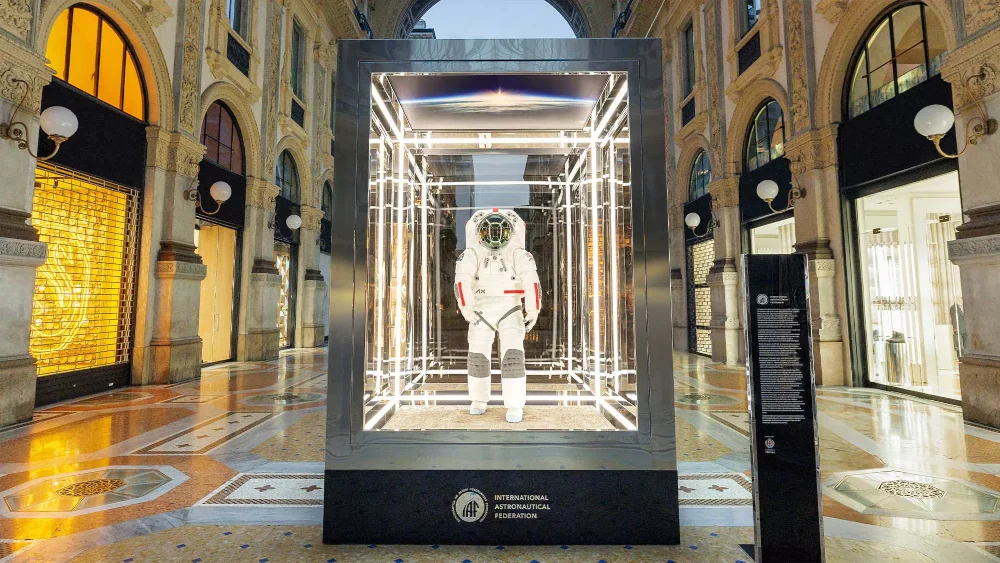
- October 2024 (Milan) — At the International Astronautical Congress, Axiom and Prada reveal the AxEMU’s outer layer, the suit’s protective shell.
- June 7, 2026 (New York) — At Prada’s SoHo Epicenter, the companies unveil the LCVG, the suit’s inner layer, worn closest to the astronaut’s body — days before NASA names the Artemis III crew.
Bertelli later noted that the New York venue lined up neatly with two other moments on Prada’s calendar: the brand’s first U.S. edition of Prada Mode, and the kickoff of the 2026 World Cup — both putting Prada’s American presence in the spotlight at the same time.
The Outer Shell: A Quick Recap
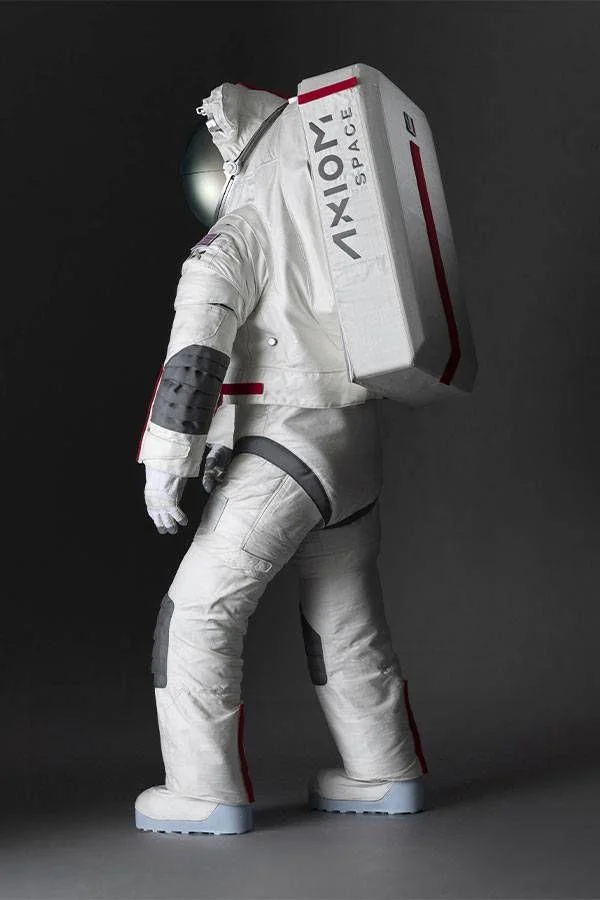
When Axiom and Prada unveiled the AxEMU’s exterior in Milan back in 2024, the focus was survival at the extremes. That outer shell was engineered to:
- Withstand the brutal temperature swings of the lunar South Pole
- Resist micrometeoroid impacts
- House redundant life-support systems and onboard diagnostics
- Support regenerable CO2 scrubbing
- Pair with custom gloves, boots, and a biometric-monitoring control interface
Axiom’s then-president, Matt Ondler, summed up the milestone simply: “We have broken the mold.”
If the outer shell is the armor, the LCVG is what keeps the person inside that armor alive.
Inside the LCVG: How It Actually Works
Sitting closest to the skin, underneath every other layer of the AxEMU, the LCVG is a form-fitting jumpsuit doing double duty as a personal climate-control system.
Cooling: a closed loop with a backup
During a spacewalk, an astronaut’s body generates significant metabolic heat — heat that has nowhere to go inside a sealed suit. The LCVG handles this with a network of flexible tubes knitted directly into the garment’s fabric, routed across the body’s major muscle groups. Cold water flows through these tubes, absorbs heat, and carries it to the AxEMU’s portable life-support system — the backpack unit — where that heat is ultimately transferred away and radiated into space. The cooled water then recirculates back through the garment in a continuous loop.
What’s genuinely new here is redundancy. The LCVG includes a second, fully independent cooling circuit that can take over instantly if the primary loop fails — something earlier cooling garments didn’t have. For a suit that Axiom’s Russell Ralston has described as “a spacecraft for one person,” that’s a meaningful safety upgrade in an environment where surface temperatures can swing from above 250°F in direct sunlight to below -410°F in permanent shadow.
Ventilation: breathing inside the suit

A separate loop of tubes handles air. Fresh oxygen is gently delivered across the astronaut’s face, while exhaled carbon dioxide is continuously drawn away and routed back to the suit’s CO2-scrubbing system for removal and recirculation.
Built to last — and to look good
The LCVG is rated for spacewalks of up to eight hours and designed for repeated use across long-duration missions, which meant Prada’s materials team had to identify and source fibers durable enough to hold up over many wear cycles.
Visually, the garment reads less like life-support hardware and more like premium technical activewear: a V-neck collar, thumbhole sleeves, throwback stirrup-style leggings, and subtle ribbed knit patterns that trace the path of the cooling and ventilation tubes underneath — almost like a map of the body’s own circulatory system. A red accent at the wrist identifies which astronaut a given garment belongs to, and Prada’s branding itself shows up almost nowhere except a single zipper pull. Everything else is buried in the knit.
From Hand-Threaded Tubes to Engineered Knitwear
To appreciate what’s actually changed, it helps to look back. The cooling garments worn during Apollo, the Space Shuttle era, and on the ISS relied on tubing threaded by hand through a mesh undergarment — effective, but slow to manufacture and limited in how precisely the tubing could be integrated into the garment’s fit.
The AxEMU’s LCVG takes a different approach: the tubes are knitted directly into channels built into the fabric during manufacturing, rather than added afterward. This is where Prada’s “engineered knitting” background comes in — and it’s also where skeptics asking whether a fashion brand’s involvement is substance or branding get their answer. Building tube channels into a knit structure, mapping them across different body types using 3D modeling, and sourcing fibers that survive hundreds of wear cycles is a manufacturing problem, not a styling one.
| Legacy LCVG (Apollo / Shuttle / ISS) | AxEMU LCVG (2026) | |
|---|---|---|
| Tube integration | Hand-threaded through mesh | Knitted directly into fabric channels |
| Cooling redundancy | Single loop | Fully redundant backup loop |
| Rated EVA duration | Shorter excursions | Up to 8 hours |
| Reuse across missions | Limited | Designed for repeated long-duration wear |
| Design input | Aerospace engineering only | Aerospace engineering + luxury knitwear and textile expertise |
Engineering Meets Haute Couture

Prada’s relationship with extreme environments goes back further than spacesuits. For two decades, the brand has supplied high-performance textiles to Luna Rossa, Italy’s America’s Cup sailing team — work built on engineered knitting and advanced 3D modeling to survive extreme marine conditions. Those same techniques and tools, it turns out, transfer surprisingly well to a very different kind of extreme environment.
Axiom CEO Jonathan Cirtain framed the collaboration as a kind of cross-industry compounding, describing the result as a garment “neither company could have created independently.” Lorenzo Bertelli, Prada Group’s Chief Marketing Officer and Head of Sustainability, described Prada’s role in terms the brand uses for its apparel lines — “design, patternmaking, and advanced materials” — just applied to a garment that will leave Earth’s atmosphere.
That sustainability framing matters too. The same advanced-fiber and engineered-knit work developed here could plausibly find its way back into Earth-bound products down the line — high-performance athletic wear or medical cooling garments aren’t a huge leap from a suit designed to manage human body temperature in the harshest environment imaginable. Neither company has announced anything along those lines, but the underlying material science doesn’t care which planet it’s used on.
Testing, Timeline, and What Could Still Go Wrong
Axiom says it plans to deliver a flight prototype to NASA before the end of 2026 for qualification testing and astronaut training — a schedule Cirtain has acknowledged is tight by aerospace standards. Pending NASA‘s sign-off, the first real-world test of the suit (and the LCVG underneath it) is expected to happen aboard the International Space Station, ahead of any lunar mission.
A few open questions remain between “unveiled” and “flight-ready”:
- Sizing across body types — 3D modeling helps, but fitting one garment design to a diverse astronaut corps while preserving the precise tube routing the cooling system depends on is a nontrivial manufacturing challenge.
- Lunar regolith — Moon dust is notoriously abrasive and clings to everything; the LCVG’s durability claims will eventually be tested against an environment Apollo astronauts described as uniquely punishing to equipment.
- Artemis III vs. Artemis IV sequencing — Axiom has said it’s prepared to test the AxEMU during Artemis III in 2027 (a crewed mission without a landing), while the suit’s intended lunar debut remains Artemis IV at the South Pole, roughly 18 months out from the June 2026 reveal.
Why This Collaboration Matters Beyond the Headlines
It’s tempting to file “Prada designs a spacesuit layer” under novelty news, but it reflects something real about how NASA builds hardware now. Since handing AxEMU development to a commercial company, NASA has effectively let Axiom shop for expertise wherever it lives — including, apparently, a Milan fashion house with two decades of competitive-sailing textile experience.
If the LCVG performs as designed, it becomes a case study for a model where non-aerospace companies contribute genuinely load-bearing components to space hardware — not just branding or merchandise tie-ins. Whether that model scales beyond this one partnership is an open question, but Axiom and Prada are clearly betting that it can.
The Bottom Line
From a protective shell unveiled in Milan in 2024 to a knitted, redundant, climate-controlled undersuit unveiled in New York in 2026, Prada and Axiom Space have now shown both major layers of the suit astronauts are expected to wear when they step onto the lunar South Pole during Artemis IV. The milestones to watch from here: a prototype delivery to NASA by the end of 2026, a test of the suit’s systems aboard the ISS, and — eventually — an Artemis IV crew putting all of this to its first real test, a quarter million miles from the nearest Prada store.

Pashalis Laoutaris
I am a professional writer, fashion blogger, and the owner of https://laoutaris.com. I have over 20 years of experience as a salesperson and 10 years of experience as a fashionista. I write daily blog articles about fashion, tools, converters, and everything you need to know about current trends.Laoutaris Recommends